


The Hidden Truth About Stop Hunting in Forex Trading (2025 Insights)
Today, we are going to explore one of the most important concepts and strategies in the Forex market, known as “Stop Hunting”. Stop Hunting is a crucial technique used by major banks and large financial institutions to enter trades and influence market movements. Forex market trends are primarily shaped by these large entities with significant capital and trading volume, who require liquidity accumulation to establish these trends.
By employing Stop Hunting, banks and financial institutions gather market liquidity and control trends. In fact, Stop Hunting and liquidity gathering serve as the main driving force behind the formation and continuation of market trends.
What areas does stop-hunting occur?
Stop hunting typically occurs around resistance zones, just above resistance levels, and also near support zones, just below support levels. At these points, the market temporarily experiences buying or selling pressure to trigger traders’ stop-loss orders and provide the necessary liquidity for subsequent moves. This behavior is more commonly observed when market liquidity decreases or when trading volumes fluctuate. In many cases, these small and short-term fluctuations create suitable opportunities for scalpers.
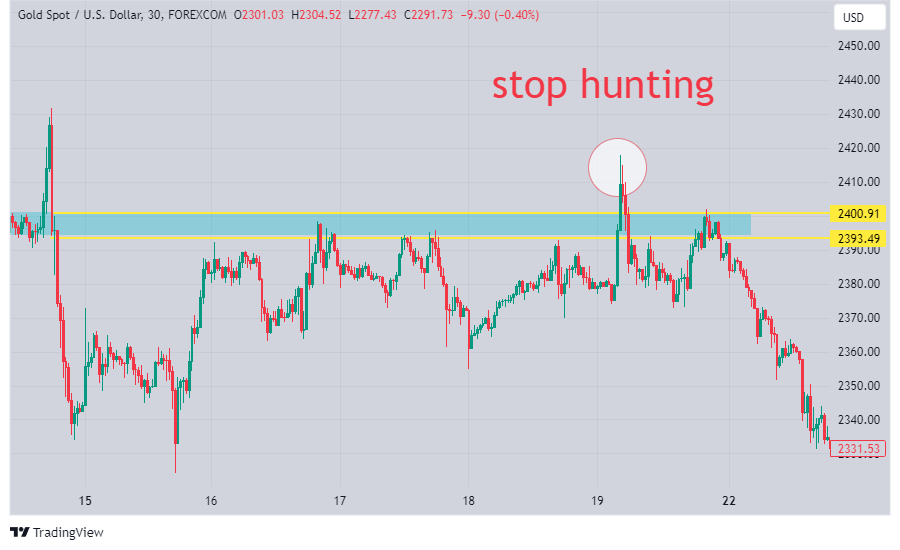
Photo by TradingView
As shown in the photo above, the market breaks our resistance zone with a quick and short-term move upward, then sharply moves down with strong momentum. Many traders had their stop-loss orders placed just above the resistance level, and this rapid upward move triggered their stop losses; this process is known as stop hunting. By temporarily breaking the resistance and moving up, the market collects the necessary liquidity before moving strongly downward. Large institutions, like big banks, trigger traders’ stop losses to gather liquidity needed to fuel trends and open their own positions.
At this zone, once the price briefly spikes above the resistance level to trigger stop losses and then moves back below the resistance area, followed by a strong bearish confirmation candle, we can enter a sell position. Keep in mind that your stop loss should be placed above the candle that caused the stop-loss hunting, the one that spiked above resistance and triggered liquidity.
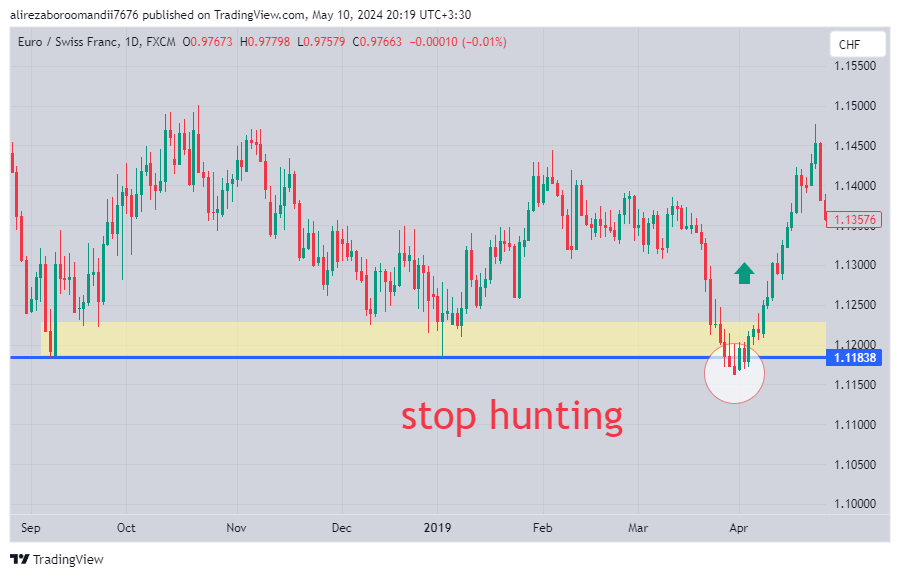
Photo by TradingView
In the example above, we have a support area where the price bounces upwards upon contact. On the third touch, the price breaks through this support and slightly dips below it. Then, after stop hunting and collecting liquidity below the support level, the price returns above the support and moves sharply and powerfully upwards.
We hope you enjoyed this tutorial.