



Two Legs Pattern in Forex Trading: Classic Strategy 2025
Price action patterns and strategies are among the most powerful and profitable tools in technical analysis. By carefully studying the market context and analyzing the market candle by candle, traders gain a deeper understanding of price behavior. Price action allows us to interpret market structure more precisely and identify potential moves with greater accuracy.
In this article, we will explore one of the most common and profitable price action setups, known as the Two Legs Pattern, and learn how traders can apply it effectively in their trading.
The market has a strong tendency to form equal legs, also known as the Two Legs Pattern. These legs are usually created by trading algorithms and computers with precise symmetry, and they frequently repeat on price charts. This consistent repetition makes it easy for traders to identify them and use them in their analysis and trading.
What Is the Two Legs Pattern and How It Forms?
The Two Legs Pattern is a popular price action setup among traders because it has a relatively high win rate and strong profitability, while also appearing frequently on price charts. The pattern is made up of two price moves that are equal or nearly equal in length. In this structure, the first leg usually forms as a relatively strong market move. After a short correction or pause, the second leg develops, typically with a length similar to the first one. An important feature of this pattern is that both legs move in the same direction: if the market is in an uptrend and the first leg forms upward, the second leg will also align with the trend and continue upward.
How to Trade the Two Legs Pattern
To trade the Two Legs Pattern, traders should first look for a relatively strong move or spike, as the initial movement indicates whether the market has enough momentum to form the second leg and continue the trend. After the first leg or initial spike occurs, the market usually undergoes a price correction, often taking the form of minor classical patterns or a price compression setup. Once the pattern breaks out in the direction of the trend, traders can enter a position for the second leg.
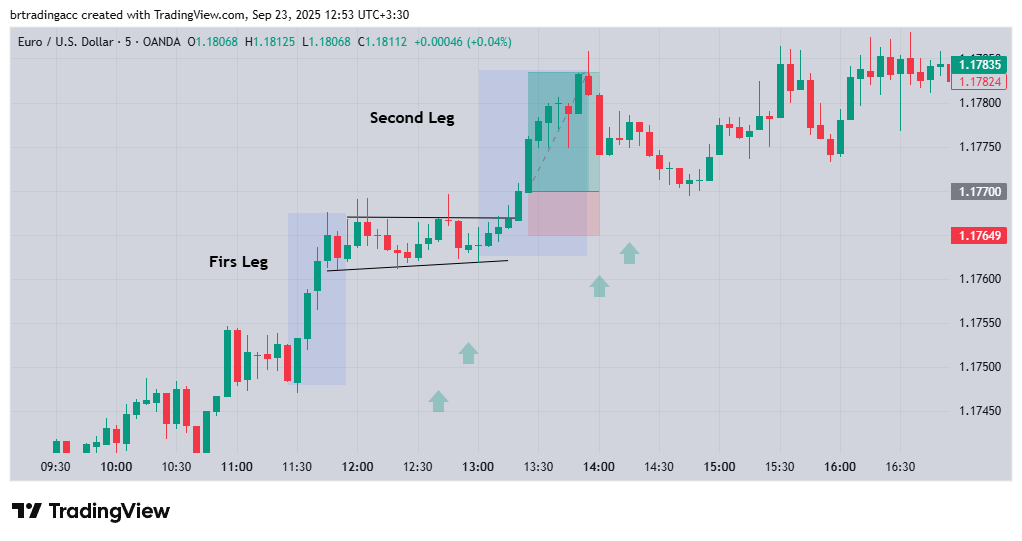
Photo by TradingView
In the chart above, we can see a Two Legs Pattern forming in an uptrend. The market initially creates the first leg with a strong spike. After a short correction and the formation of a price compression pattern, the market breaks the pattern to the upside, forming the second leg.
To trade this setup, traders can enter a long position when the pattern breaks upward with a strong bullish candle, effectively trading the second leg.
Also, keep in mind that when trading the second leg, your take profit should not exceed the size of the first leg. The reason is that, according to price action structure, the market usually has the capacity to move only up to the size of the first leg. Setting a take profit larger than the first leg may result in the market failing to reach your take profit, potentially closing the trade at a loss. Therefore, when determining your take profit, what matters is a logical target based on price action and the market’s actual movement.
Why Are Equal Legs So Accurate and Frequently Repeated in the Market?
If you carefully observe the charts after understanding the Two Legs Pattern and equal legs, you’ll notice that these legs appear frequently, both in uptrends and downtrends. Sometimes, these legs are almost perfectly equal in size because trading computers and algorithms create them with highly precise mathematical calculations. Trading computers execute high-volume orders that shape candles and legs, showing a strong tendency to form equal legs.
Additionally, trader psychology plays a role: after seeing the first leg, traders expect the market to form a second leg following a minor correction, which further contributes to the formation of equal legs.
We hope this article has been helpful for you